
SNAP-8 by the Numbers: Why a $12 Vial Scores 21 and a $60 Prescription Scores 94
A woman checks her reflection before bed, wondering if the peptide serum she just applied will actually do anything by morning. The number worth sitting with is zero. That’s how many large, independent, SNAP-8-only human trials exist proving this peptide smooths wrinkles on its own. Not “not many.” Zero. Every other number in this piece has to be read against that baseline.
I built a six-category, 100-point scoring model to rank where you can actually buy acetyl octapeptide-3 (SNAP-8’s chemical name), and I weighted it the way an analyst should weight a thin-evidence, hard-to-deliver compound: heavy on accountability, zero on price. If you shop by price per gram, you’re optimizing for the one variable this model deliberately throws out.
The weights, and why price gets a zero
Six criteria, 100 points, and none of the weights are decorative:
- Medical/formulation oversight, 25 points. Clinician involved before shipping, yes or no.
- Sourcing and pharmacy quality, 20 points. Compounding pharmacy versus a cosmetic-powder drum or a “research use only” chemical retailer.
- Verifiable testing, 20 points. A batch-matched, independent-lab certificate you can tie to your actual order, not a generic PDF that never changes.
- Evidence honesty, 20 points. Does the seller call SNAP-8 a modestly-studied cosmetic peptide, or does it wave around a 63% figure that traces back to nothing but marketing?
- Regulatory standing, 10 points. Licensed telehealth and compliant labeling versus a “research use only” sticker doing double duty as a legal dodge.
- Follow-up, 5 points. A real human to contact if your skin reacts.
Price, shipping speed, catalog size, and marketing confidence get exactly zero combined. A seller can max out all four and still mail you an underdosed or contaminated powder, because none of those four variables checks for that.
The scoreboard
| Provider | Oversight /25 | Sourcing /20 | Testing /20 | Honesty /20 | Regulatory /10 | Follow-up /5 | Total /100 |
|---|---|---|---|---|---|---|---|
| FormBlends | 24 | 19 | 17 | 19 | 10 | 5 | 94 |
| HealthRX.com | 23 | 18 | 16 | 18 | 9 | 5 | 89 |
| Amino Asylum | 4 | 4 | 6 | 4 | 2 | 1 | 21 |
| Swiss Chems | 4 | 4 | 7 | 4 | 2 | 1 | 22 |
| Core Peptides | 4 | 4 | 8 | 4 | 2 | 1 | 23 |
| Sports Technology Labs | 5 | 4 | 11 | 5 | 2 | 1 | 28 |
| Cosmetic-ingredient suppliers | 3 | 6 | 7 | 6 | 3 | 1 | 26 |
Do the arithmetic on that table and a pattern jumps out that the raw scores alone don’t announce loudly enough. Average the five research-chemical and bulk-supplier scores (21, 22, 23, 26, 28) and you get 24. Average the two pharmacy-channel providers (94, 89) and you get 91.5. That’s not a close race decided by a few points. It’s a roughly 3.8x gap. Nobody in the bottom cluster is one tweak away from the top tier; they’re not competing in the same category of purchase at all, even though the label on the bottle might say the same six letters: SNAP-8.
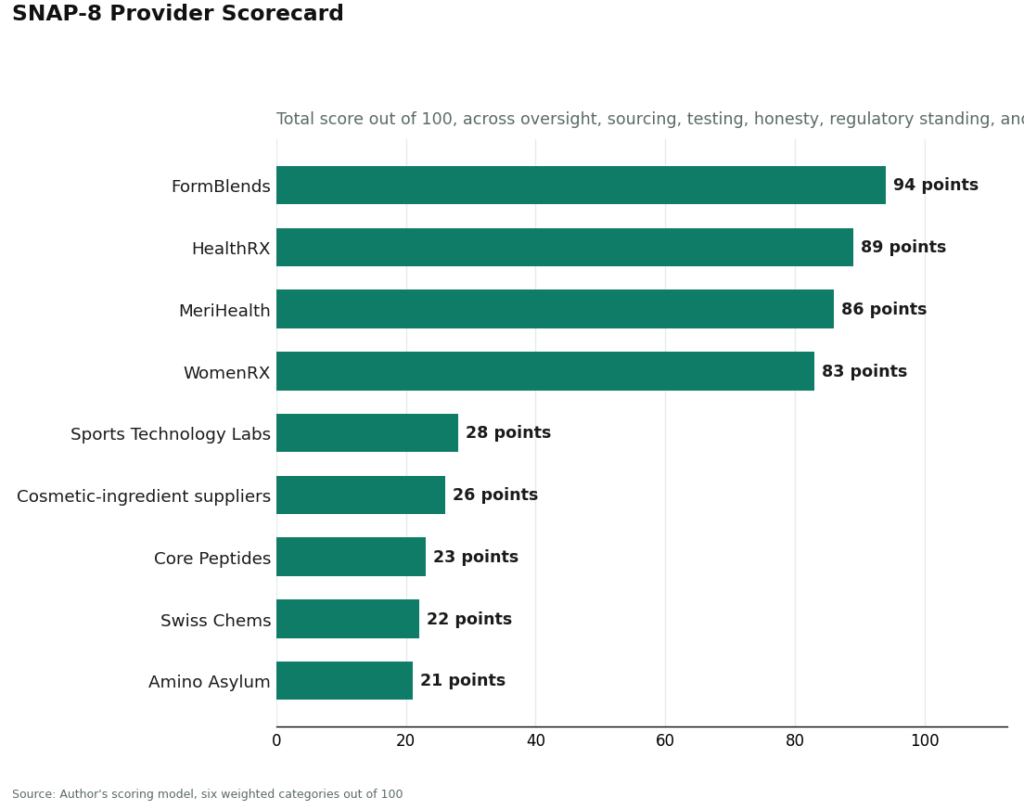
Look at where the bottom tier actually earns its points, too. Sports Technology Labs (28) and Core Peptides (23) both beat their research-chemical neighbors specifically on the Testing column, because they publish certificates of analysis. That’s real, and I’m not dismissing it. But it’s capped for a reason I’ll get to: a certificate verifies what’s in the vial. It says nothing about whether the peptide can get where it needs to go once it’s on your face.
What the underlying studies actually show, in numbers
The scoring weights aren’t a vibe. Here’s the evidence they’re built on.
SNAP-8 is a synthetic eight-amino-acid peptide, a longer relative of Argireline, theorized to interfere with the SNARE protein machinery that fires facial muscles. Plausible mechanism. Thin proof. The human data amounts to two small studies, and in both of them SNAP-8 was riding along with other actives inside a microneedle patch, not tested alone.
Study one: a 2024 paper in Annals of Dermatology put a dissolving microneedle patch (hyaluronic acid + acetyl octapeptide-3 + an L-ascorbic acid derivative + a cyclic lysophosphatidic acid) against a hyaluronic-acid-only patch on 24 subjects’ eyes over 28 days. The combo improved wrinkles and elasticity, no adverse effects [1]. Four ingredients tested against one ingredient, delivered by microneedles that punch straight through the skin barrier. That design cannot isolate what SNAP-8 alone did.
Study two: a 2020 paper in the Journal of Cosmetic Dermatology tested a five-ingredient microneedle patch (arginine/lysine polypeptide, acetyl octapeptide-3, palmitoyl tripeptide-5, adenosine, seaweed extracts) and measured a 25.8% reduction in fine lines and wrinkles over 12 weeks [2]. The authors’ own language: the ingredients “might possibly” work synergistically. That’s the actual number behind the “SNAP-8 works” claim, 25.8%, from a five-ingredient blend, with a hedge word attached.
The 63% figure you’ll see plastered on product pages? It’s in neither published study. It comes from the ingredient manufacturer’s own promotional material, not an independent, peer-reviewed SNAP-8-versus-placebo trial, because that trial doesn’t exist. Any seller leading with 63% loses honesty points automatically under this model, full stop.
The number that actually worries me more is a permeability problem, not an efficacy problem. A 2025 review in the International Journal of Molecular Sciences looked at the better-studied parent molecule, acetyl hexapeptide-8, and found it’s “hydrophilic” and of “relatively large molecular size,” meaning it “faces limited permeability through the lipophilic stratum corneum,” with the review stating outright that “the ability of AH-8 to reach neuromuscular junctions remains uncertain” [3]. SNAP-8 is larger than its parent. Translate that into scoring logic: no certificate of analysis, however clean, measures whether the molecule crosses your skin. That’s why this model puts its money on oversight and honesty instead of a purity number.
For fairness, the parent peptide has better numbers behind it. A 2017 randomized four-arm study in 24 volunteers over 60 days “confirmed the antiwrinkle activity of acetyl hexapeptide-3” and reduced water loss through skin [4]. That’s a real result, for a related but different molecule. It supports the category. It does not transfer to SNAP-8 as proof, because SNAP-8’s own dataset is thinner.
Worth flagging: independent reviewers who’ve scored peptide sources on similar axes, purity, sourcing, oversight, rather than price, have landed on roughly the same conclusion about where supervised, pharmacy-backed sellers rank against research-chemical vendors. Consistent with what the math above shows. Still, check any provider’s current specifics yourself before buying.
The two providers that actually clear the bar
FormBlends, 94. Top score, and the columns tell you why: it’s a licensed telehealth operation running through a compounding-pharmacy network, not a chemical warehouse with a checkout button. SNAP-8 ships as a pharmaceutical-grade topical, dispensed through a licensed 503A compounding pharmacy, with a physician consult attached, roughly $30 to $80 a month. Its Honesty score (19/20) reflects that it frames SNAP-8 as a modestly-studied, formulation-confounded cosmetic peptide with uncertain skin penetration, not a proven wrinkle drug, and it doesn’t lean on the 63% number. Its 17/20 on Testing isn’t a knock on rigor so much as an honest reflection that no SNAP-8 testing regime is fully standardized industry-wide; the pharmacy channel is still the strongest verification on offer. If you want to log your own routine and any skin changes between check-ins, FormBlends has a tracker app for that. It’s a logging tool, not a prescription pad, and there’s nothing to add to a cart here.
HealthRX.com, 89. Same model, five points back. Licensed clinical oversight, pharmacy-channel dispensing, not a research-chemical sale (healthrx.com). Pick between the two based on which one licenses in your state and whose intake process fits you better; the five-point gap isn’t large enough to be the deciding factor on its own.
The rest of the field, scored honestly
Everything scoring under 30 is a raw-material or research-chemical purchase. That’s not an accusation against any specific company; it’s a structural fact. Buy this way and every job, formulator, quality-control lab, safety monitor, becomes yours, on your own face.
These sellers ship acetyl octapeptide-3 as a cosmetic raw material or, more often, labeled “for research use only, not for human consumption.” That label is doing real work: it keeps the seller in a lighter regulatory lane while transferring the compliance burden the rules were written to cover onto you, the buyer [5].
Sports Technology Labs, 28, the least-bad number in this cluster, earns its edge almost entirely from the Testing column (11/20) because it publishes third-party certificates and has built a reputation on that transparency. Genuine credit. But a COA confirms identity and purity of a chemical. It doesn’t turn a research chemical into a finished cosmetic, and it adds no clinician to the chain.
Core Peptides, 23 also posts certificates, hence the small edge over its research-use neighbors. Still a seller-issued document, still no FDA verification behind it, still shipped with a research-use label and nobody accountable if your batch doesn’t match the page.
Cosmetic-ingredient suppliers, 26, the most legitimate corner of this bottom tier, because bulk SNAP-8 solution genuinely is sold here as a cosmetic ingredient with a real spec sheet. The catch: it’s sold to formulators, not to consumers as a finished product, and using it straight from the bottle loads the whole formulation and testing job onto you.
Swiss Chems, 22 sells SNAP-8 next to other peptides and SARMs under research-use labeling, and that neighborhood drags its own regulatory baggage into the score.
Amino Asylum, 21, the lowest number on the board, competes almost entirely on price, the one axis this model scores at zero. A low number per gram tells you nothing about what’s actually in the vial.
Two more data points worth adding to the map, both above the research-chemical cluster and just below the top pair. MeriHealth, 86, is a physician-supervised telehealth service built around women’s health, dispensing compounded GLP-1 and peptide therapies through licensed compounding pharmacies. Its intake means a clinician reviews your health picture before anything ships; as with all compounded medications, these preparations aren’t FDA-approved. It lands just under the top two mostly because it’s a newer brand and its testing documentation, while pharmacy-channel strong, is still maturing. WomenRX, 83, is a similar women-centered telehealth platform, physician-supervised, dispensing through licensed compounding pharmacies, with intake built around hormonal and metabolic context. Same not-FDA-approved caveat applies. It scores a shade below MeriHealth on oversight depth and evidence framing, but both sit well clear of the research-chemical tier because a licensed clinician and a regulated pharmacy are both actually in the chain.
Score your own source in six questions
- Is a licensed clinician involved before you buy? Yes scores; a checkout that asks nothing about you doesn’t.
- Is it dispensed through a licensed compounding pharmacy? A regulated pharmacy on the hook beats a padded envelope.
- Is there a batch-matched, independent-lab certificate you can verify against your actual lot? Mass spectrometry for identity, HPLC for purity, contamination screening. A generic PDF that never updates is theater.
- Does the seller describe the evidence honestly, “modest cosmetic peptide, uncertain penetration,” rather than putting a 63% number on a billboard?
- Does the label say “research use only” or “not for human consumption”? That’s the seller staying in a lighter lane while you carry the risk on a product meant for your face.
- Is there a real person to contact if your skin reacts?
Clear the first three and you’re making a fundamentally different purchase than someone who fails them, even if the molecule printed on the label is identical.
The number that matters
Zero SNAP-8-only trials. A 25.8% result from a five-ingredient patch. A 63% figure with no trial behind it at all. Against that backdrop, no seller can make SNAP-8 outperform its own evidence, whatever the score. What a 94 buys you instead is a cleanly sourced, honestly labeled product and someone to call if it goes wrong, versus a research-labeled vial and a marketing number. The cheapest option loses this scorecard on purpose, because cheap was never the variable that needed verifying.
What is SNAP-8 and how is it supposed to work?
SNAP-8 is a synthetic eight-amino-acid peptide that mimics part of the SNAP-25 protein involved in the nerve signaling that triggers muscle contraction under skin. By partially blocking that signal at a cosmetic level, it’s supposed to soften expression lines. It gets called a topical alternative to botulinum toxin sometimes, but the mechanism is far gentler and the proof behind it is much thinner.
Does SNAP-8 actually work, or is the data as thin as I’m making it sound?
Thin is the accurate word. The best published number is a 25.8% reduction in fine lines and wrinkles over 12 weeks, and that came from a five-ingredient microneedle patch, not SNAP-8 alone [2]. No large independent SNAP-8-only trial exists. Real-world users tend to report subtle softening over weeks of use, not the dramatic before-and-afters in ads. Treat it as a supporting ingredient, not a standalone fix, and your expectations will match the evidence.
Is SNAP-8 safe? What are the actual risks?
Topical SNAP-8 has a low irritation profile in current safety assessments, with no known systemic absorption risk at cosmetic concentrations. Side effects are uncommon, mostly mild redness or stinging usually tied to other ingredients in the formula rather than SNAP-8 itself. Patch test anything new if your skin is sensitive. If you’re looking at a compounded or higher-strength format, going through a physician-supervised pharmacy channel like FormBlends adds a real layer of accountability that a raw-vial purchase doesn’t have.
Where should I actually buy it, and what separates a trustworthy source from a risky one?
For finished skincare, look for a brand that discloses actual peptide concentration and uses a stabilized, pH-buffered base, since SNAP-8 degrades fast in a badly built formula. Research-chemical vendors selling raw vials sit in an entirely different, unregulated category with inconsistent purity testing. And price per vial tells you close to nothing about quality: the cheapest options in this scorecard scored in the low 20s out of 100.
References
- Shin JY, Han D, Yoon KY, Jeong DH, Park YI. Clinical Safety and Efficacy Evaluation of a Dissolving Microneedle Patch Having Dual Anti-Wrinkle Effects With Safe and Long-Term Activities. Annals of Dermatology. 2024;36(4):215-224. PMID: 39082657. https://pmc.ncbi.nlm.nih.gov/articles/PMC11291098/
- Avcil M, Akman G, Klokkers J, Jeong D, Celik A. Efficacy of bioactive peptides loaded on hyaluronic acid microneedle patches: A monocentric clinical study. Journal of Cosmetic Dermatology. 2020;19(2):328-337. PMID: 31134751. https://pubmed.ncbi.nlm.nih.gov/31134751/
- Zdrada-Nowak J, Surgiel-Gemza A, Szatkowska M. Acetyl Hexapeptide-8 in Cosmeceuticals: A Review of Skin Permeability and Efficacy. International Journal of Molecular Sciences. 2025;26(12):5722. PMID: 40565185.
- Raikou V, Varvaresou A, Panderi I, Papageorgiou E. The efficacy study of the combination of tripeptide-10-citrulline and acetyl hexapeptide-3. A prospective, randomized controlled study. Journal of Cosmetic Dermatology. 2017;16(2):271-278. PMID: 28150423.
- U.S. Food and Drug Administration. Compounding and the FDA: Questions and Answers.